
LinkRF
EME and Weak signal communication


Copyright © 2008-2026, Eich Switzerland by Alex Artieda, HB9DRI

DRILNA series
High OIP3 EME preamp (50, 144, 432MHz)

DRILNA series is based on the concept of a "STOP NF CULT," where the desperate search for the lowest NF value has led to generations of preamplifiers that do little to combat interference because they are not selective enough. In simpler terms, they are broadband and have very poor input return loss. All this because the only thing that has been pursued for decades, with considerable success, is obtaining preamplifiers with the lowest NF value, but at the cost of a poor IRL, excessive bandwidth, and consequently, a very poor IM3 response. However, this desperate pursuit of the lowest NF value has yielded great results when the EME station was installed in a relatively calm RF environment, something that is now almost nonexistent.
My approach to the problem goes in the opposite direction: maximizing the IM3 response with the highest possible OIP3 value, eliminating bandwidth as much as possible, and using the NF values as a trade-off currency, at least to the point where the trade don't affect the signal-to-noise ratio or if afect is minimal. I've been testing this for several years, and nowadays other stations are starting to use this concept—"painful" for "NF cult" enthusiasts, but convincing and effective for those who try it.Once you've tried it, you'll never again follow the archaic concept of: "...you shouldn't install anything in front of the preamplifier that increases the IL and consequently the NF value..." WHY? Well, in lower bands, and I'm speaking strictly in bands from 28 MHz to 432 MHz, the sky temperature dominates the noise contribution. So let's use this noise contribution to our advantage. HOW? i will tel you how in the next lines.
By introducing a high-performance bandpass filter in front of the preamplifier—yes, in front of the preamplifier. For this, we must look for a BPF with the lowest possible insertion attenuation, and after years of searching, the best I've found with excellent results are the filters designed by GORAN YU1CF of Antennas-Amplifiers.
Introducing an excellent BPF before the preamplifier intrinsically requires that the preamplifier have a good IRL (Insertion Loss). Otherwise, the BPF won't work correctly because the filter won't "see" 50 ohms but something much weaker. The result will be a detuned filter with increased ripple and ringing, and a poor attenuation response. Unfortunately, all our preamplifiers have a very poor IRL by default, usually around 4 to 8 dB. The best reach 10 or 12 dB, but always in broadband, which is neither helpful nor useful in the RF-contaminated environments we operate in today.
The DRILNA is the answer to this mistaken concept of "NF CULT" where, in order to obtain the lowest NF values, we have created preamplifiers that are unusable in highly RF-contaminated environments.
In the following calculations, we will demonstrate that installing the BPF before the preamplifier does increase the final NF value, but in the 144MHz band, this represents a negligible signal-to-noise loss. As I mentioned earlier, I will use the NF value as a bargaining chip to obtain a more robust front-end against outband interference by increasing the NF value by a few tenths of a dB.
For this to be achieved, it's crucial that the preamplifier is well-designed. Of course, we'll strive to keep the preamplifier's NF value as low as possible. At the same time, we must ensure the optimal IRL (Input Return Loss) because if the BPF (Bandpass Filter) doesn't "see" the 50 ohms it's designed for, many unwanted effects occur in the filter, such as noise, ringing, excessive ripple, detuning, poor bandwidth response, and, above all, an excessive increase in IL (Insertion Loss), which would raise the final NF value to levels where the signal-to-noise ratio would be negatively impacted. All these parameters are in conflict; that is, we can optimize the IRL but at the cost of an excessive increase in NF and a loss of gain.
Manufacturing itself isn't problematic, but calibration is and requires hours of work because there's a significant trade-off between all the parameters. We gain in one parameter at the expense of others; it's a complex trade-off. I've developed my own calibration sequence, which has allowed me to achieve a perfect balance between all the required parameters. That's why in the "NF Cult", people have optimized preamplifiers for years solely from the NF perspective. This worked when we didn't have the RF signal density we have now. Today, those preamplifiers with magical NF levels are just a source of problems that nobody wants to acknowledge because installing a bandpass filter (BPF) upstream of the preamplifier is painful and difficult by de NF adicts, but in reality, it isn't, and that's what I'm going to demonstrate here.
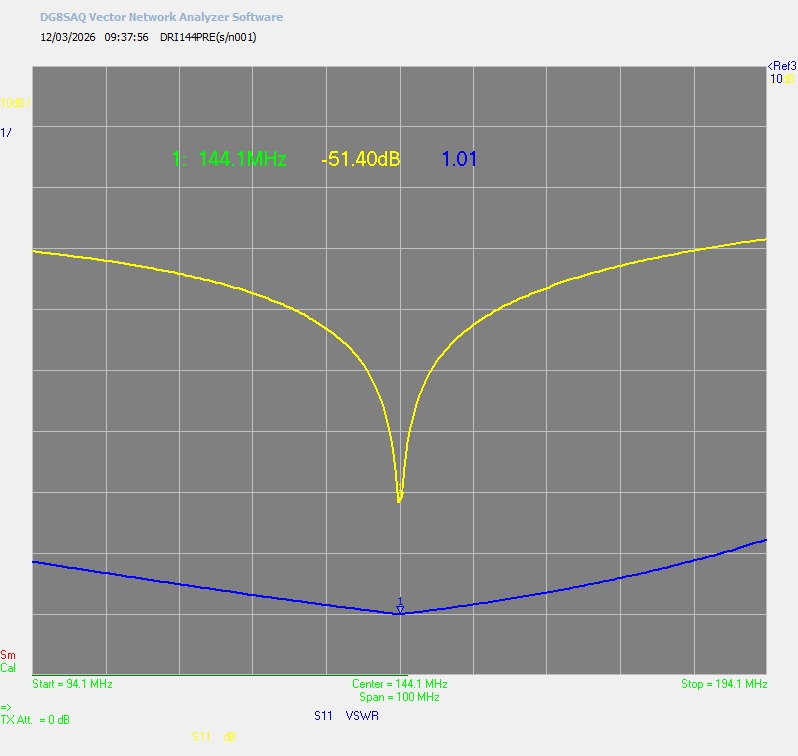
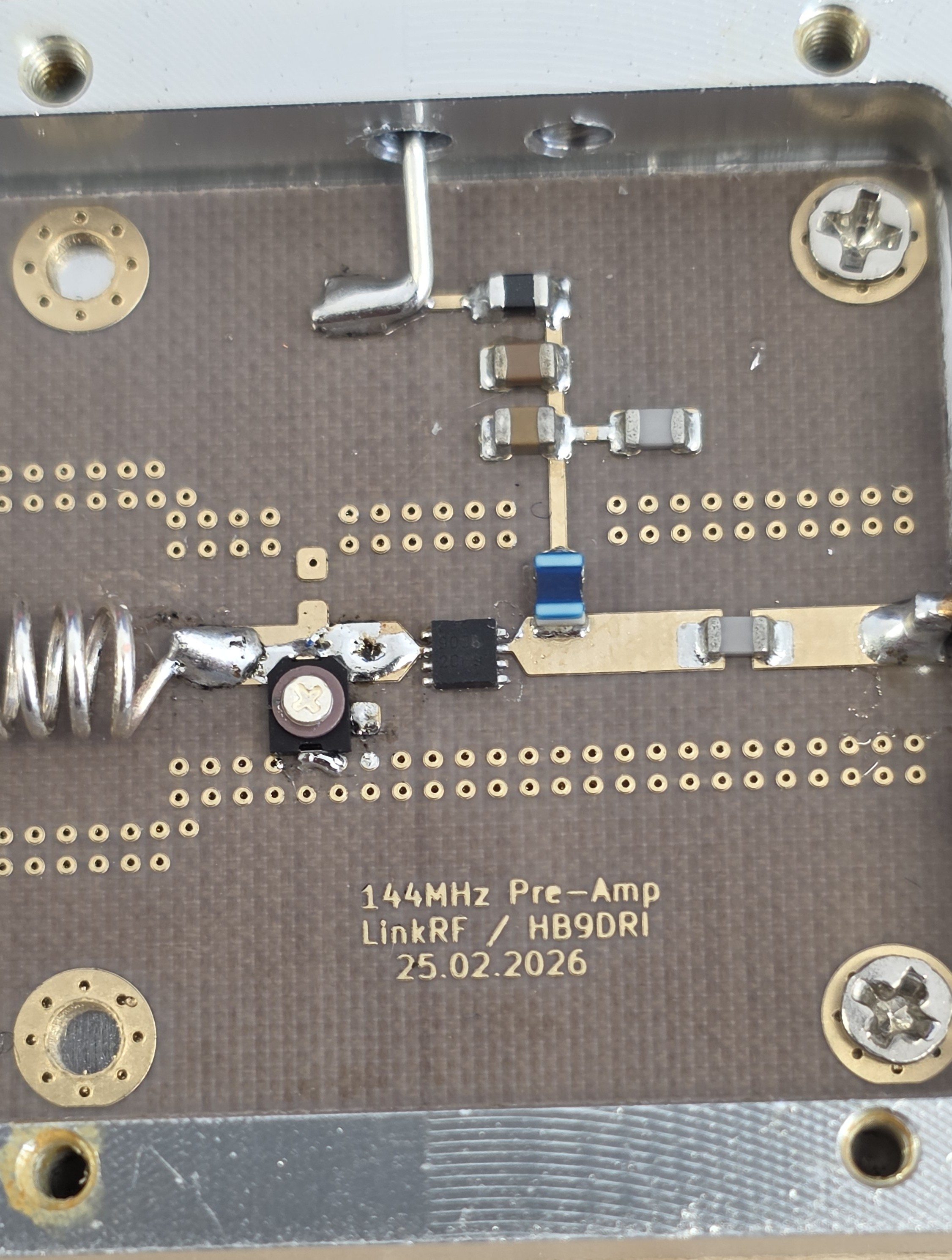
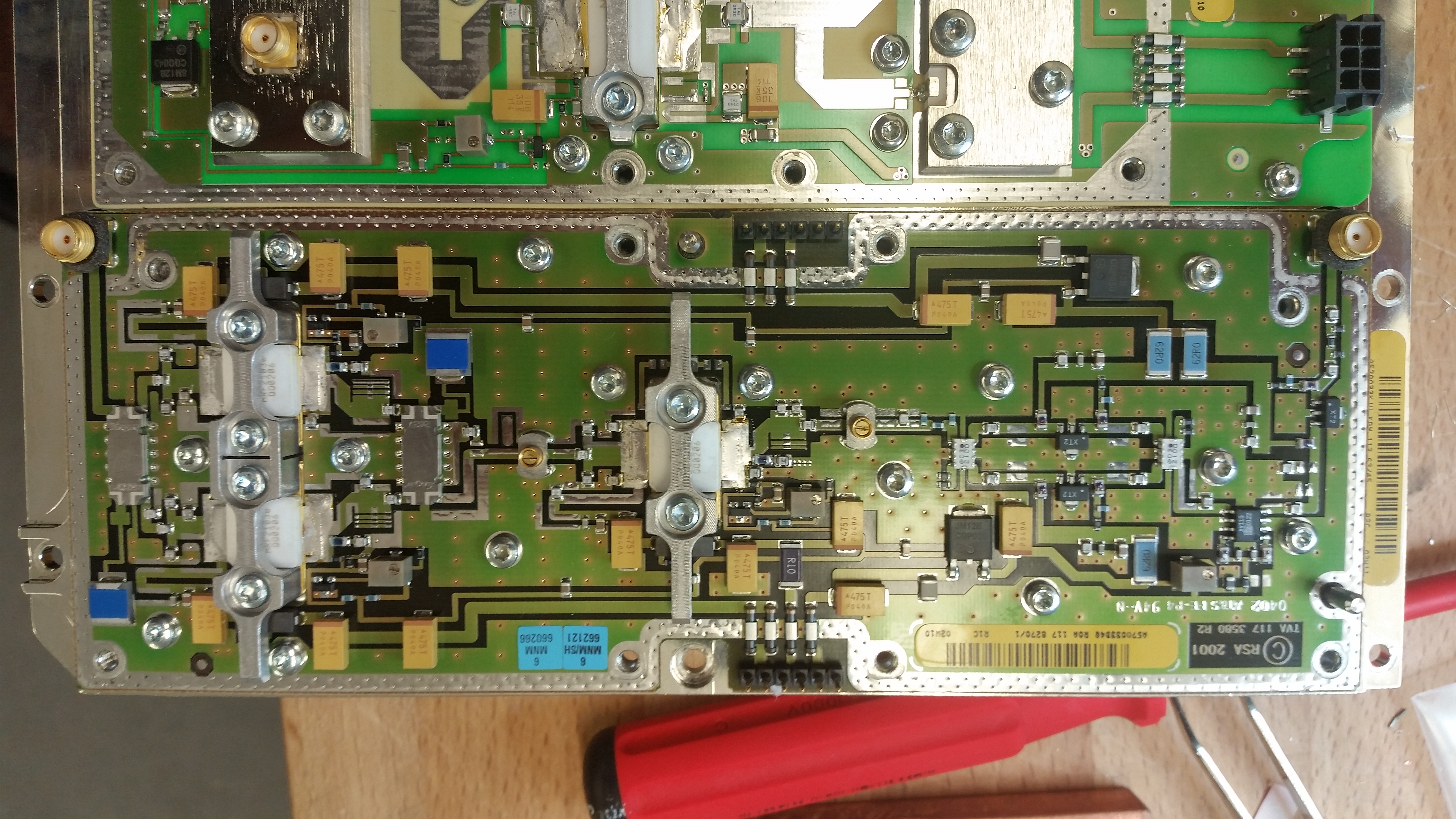
The DRILNA144 use the TQP3M9036, high linearity, ultra-low noise
gain block amplifier optimized for lower bands 50 to 2000MHz
LinkRF use a new PTFE gold plate pcb for the DRILNA series,
not any more FR4 pcb to avoid unnecesary losses
Using the temperature of the sky as an ally
As is known, the sky temperature in low bands (50 to 432 MHz) is considerably higher. Consequently, any variation in the preamplifier's noise figure (NF) will represent a percentage of the total noise that is completely dominated by this "sky temperature." If the sky temperature is very high, a small variation in the preamplifier's NF will have a minimal effect on the system's signal-to-noise ratio (SNR). However, if the sky temperature is low, then that same variation will have a much greater effect on the SNR.
Let's use a practical example:
1) Filter loss directly increases receiver noise figure
If a passive filter with insertion loss L is placed before the LNA, its noise factor is simply:

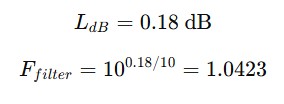
In Goran's filter that "noise factor" is:
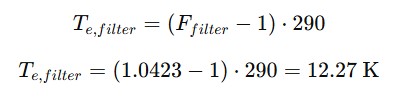
In consequence the equivalent noise temperaure added by Goran's filter is:
CONCLUSION 1:
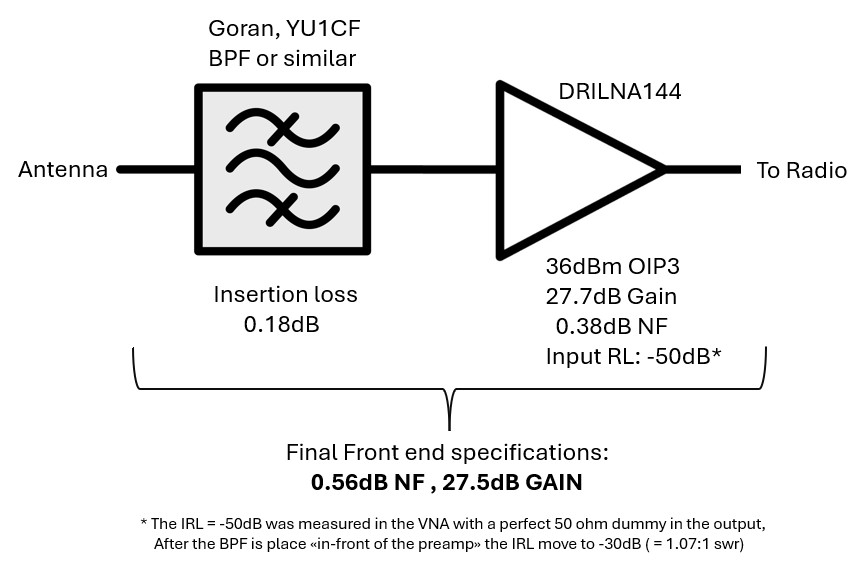
Having a BPF with 0.18dB insertion loss represent a noise factor of 1.0423 equivalent to a Noise Temperature of 12.3 K (kelvin degrees)
2) Convert DRILNA noise factor into noise temperature:
The noise factor for the DRILNA will be:
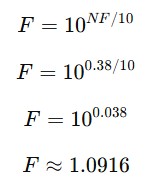
and the Equivalent noise temperature will be:
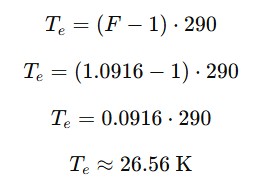
CONCLUSION 2:
The DRILNA with 0.38dB NF has a noise factor = 1.0916 equivalent to a Noise Temperature of 26.56 K (kelvin degrees)
3) Total Front-end temperature and NF:
Front-end temperature in kelvin degrees:
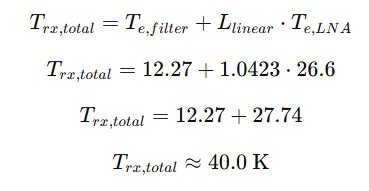
Total fron-end (BPF+DRILNA) Noise figure in dB:
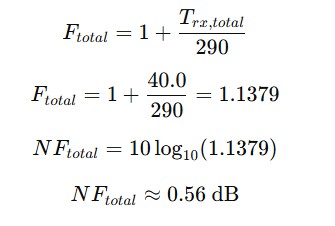
PLACING A BPF WITH 0.18dB IL AHEAD OF THE DRILNA (0.38dB NF) RESULTS IN A TOTAL OF 0.56 dB NOISE FIGURE FOR THE FRONT-END
BECOUSE THE DRILNA HAS A EXCEPTIONAL IRL (-50dB) AND LOW NF AND HIGH GAIN THE GORAN's BPF FIT COMFORTABLE AND DELIVER ALL HIS SHARP CHARACTERISTICS; CONVERTING A BROADBAND AMPLIFIER IN A EXTREAMLY NARROW BAND PREAMPLIFIER WITH +36dBm OIP3 CAPABLE TO FIGHT AGAINST IM3 PRODUCTS ORIGINATED BY OUTBAND SIGNALS
But the question that now arises is:
How does the NF increased from 0.38dB to 0.56dB affect the signal-to-noise ratio (s/n), and what role does sky temperature play?
4) Effect of Sky Temperaure at 144 MHz:
The Total system temperature is expresed by:
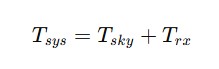
Lets make a comparative calculation Case A (no filter DRILNA 0.38dB NF) vs Case B (BPF+DRILNA)
Case A - No filter (0.38dB NF DRILNA)
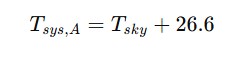
Case B - with filter (0.56dB NF BPF + DRILNA)
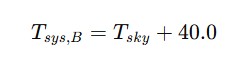
SNR degradation:
Is calulated by:
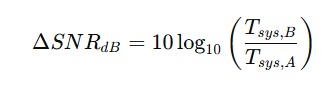
Calcuations for 3 typical sky temperature values at 144 MHz
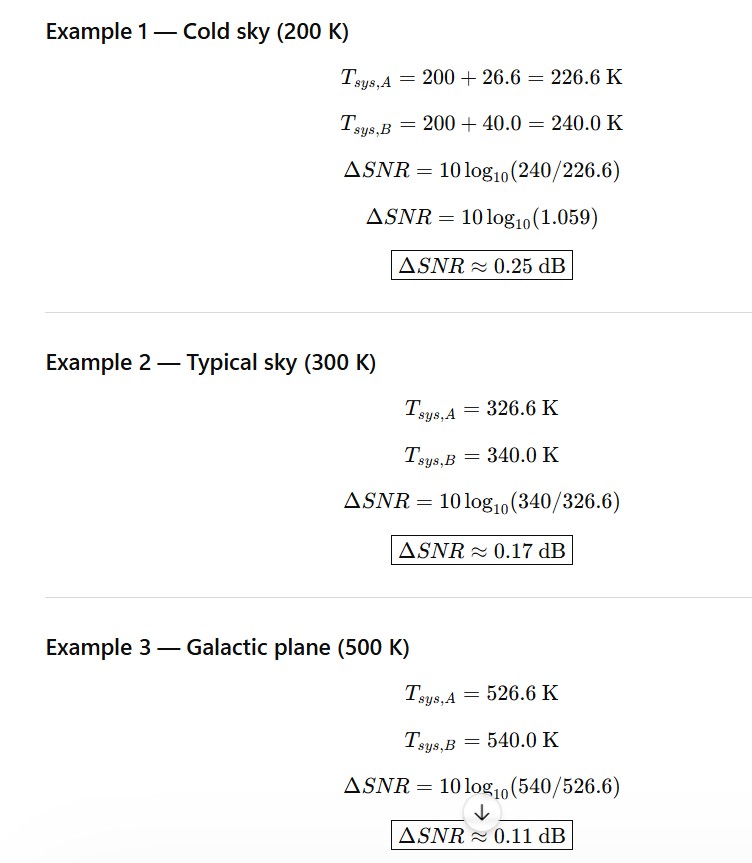
PLACING A BPF AHEAD THE PREAMPLIFIER GIVE YOU A VARIATION OF THE S/N IN A MEDIA OF ONLY 0.2dB DEPENDING WHERE YOUR ANTENNA IS POINTING THE SKY. THIS IS A WINING TRADE PRACTICE WHERE A SMALL INCREMENT IN THE NF GIVE YOU A MUCH QUIET RECEIVER, ALLOWING TO RECOVER THE BAND FUNCTIONALITY DUE THE ABSENCE OF BROADBAND RESPONSE AND HIGH OIP3 LEVEL IN THE PREAMPLIFIER
FINALLY:
At 144 MHz, the sky temperature is already on the order of a few hundred kelvin in many directions. Therefore, reducing receiver noise figure from 0.56 dB to 0.38 dB improves total system temperature only slightly.
By contrast, adding a 0.18 dB low-loss sharp BPF ahead of a well-matched, high-linearity preamp dramatically improves dynamic range and suppresses IM3-driven noise-floor lift, SOMETHING VERY CRITICAL TO EME, SPECIALLY FOR DIGITAL MODES
The true system trade is therefore not “0.38 dB versus 0.56 dB NF,” but rather “a theoretically quieter receiver” versus “a practically cleaner and more usable EME band.”
On 144 MHz, because sky temperature is already high, the dynamic-range improvement is often worth far more than the very small thermal penalty.
STOP the NF CULT