
LinkRF
EME and Weak signal communication



Performance comparision
DRILNA144 vs MKULNA144

Copyright © 2008-2026, Eich Switzerland by Alex Artieda, HB9DRI
When comparing two systems or devices, one should always look for a good reference point. In this case, from a very large selection of preamplifiers, I've chosen the famous Michael DB6NT MKU-LNA-144. I personally have used this preamplifier for many years in our HB9Q installations. Furthermore, for the complete IQ+ design in all its versions (A, B, C, and D) and the new IQ+ PRO, I've always used the MKULNA144 due to its excellent characteristics. I have no intention of disparaging the MKULNA144; on the contrary, this is a tribute to the many years this preamplifier has served hundreds of Moonbounce stations. Kuhne products are renowned for and reflect high-quality German engineering.
Before starting, I must mention that the MKULNA144 was conceived in an era where out-of-band interference did not represent a serious problem as it does today. It is necessary to mention this. Unlike the MKULNA144, the DRILNA144 is designed and focused on working in hostile RF environments and is specially adapted to withstand a BPF upstream of the preamplifier, something that the MKULNA144 does not tolerate very well due to its low IRL level.
Preamp
|
DRILNA144
|
MKULNA144
|
Gain
|
27.0dB
|
26.0dB
|
NF
|
0.38dB
|
0.40dB
|
OIP3
|
+36dBm
|
+24dBm
|
IIP3
|
+8.3dBm
|
-2.0dBm
|
IRL
|
-30.0dB*
|
-1.0dB
|
This comparison focuses on Input Linearity (IIP3), which is the most critical spec for handling strong interfering signals. While both preamplifiers offer excellent noise figures (NF), the DRILNA144 provides a massive advantage in its ability to handle "hostile" signal environments.
To compare them fairly, we must first convert the Kuhne MKULNA144 and DRILNA144 specs to the same standard: IIP3 (Input Third-Order Intercept Point). This value is already express in the table but it was not gived, never the less the IIP3 was found just in a simple way:
IIP3 = OPI3 - GAIN
The DRILNA144 has an IIP3 that is 11.00dB higher than the MKULNA144
To understand properly those diferences in IIP3 we must talk about the "2-for-1" advantage rule
Lets asume 2 preamps, preamp1 = 0dB IIP3 vs preamp2 = +9dB IIP3
Following the 2-for-1 rule when you improve the IIP3 of a system, the reduction in distortion is always double the increase in the IIP3 value. Here is why:
1.- The Difference: Your new preamp has an IIP3 that is 9 dB higher than the old one
2.- The Math: For third-order distortion, the formula for the level of the distortion products is:

Now in our specific case of DRLNA144 vs MKULNA144 give to use this inital results:
Analysis of the Advantage
1.- 20.6 dB Reduction in "Garbage": Following the "2-for-1" rule we discussed, the DRILNA144's 10.3 dB higher intercept point means its internal intermodulation distortion (the "phantom signals" created by strong neighbors) will be 20.6 dB lower than the MKULNA144 for the same input signal.
2.- Handling Strong Interference: If you are in an environment with strong local signals (like a nearby FM station or a crowded radio contest), the MKULNA144 will "choke" or produce audible distortion far sooner. The DRILNA144 can handle signals that are over 10 times more powerful ( 10^1.03 ) before reaching the same level of nonlinear behavior.
3.- Spurious-Free Dynamic Range (SFDR): The DRILNA144 expands your usable dynamic range by nearly 7 dB. This is the difference between hearing a weak EME station and having it masked by "splatter" from a strong station a few kHz away
Sumary Verdict:
The DRILNA144 is a high-linearity powerhouse. While the MKULNA144 is a legendary, high-quality German-engineered LNA with a very competitive noise figure, the DRILNA144 is specifically designed to survive in high-signal environments where most other preamps would fail due to intermodulation.
WHY ?
Becouse for decades EME operator give excess importance only to the NF, almost ALL EME preamps suffer from the same problems, they are broadband, they have poor Input Return Loss and the IIP3 dos not match the requeriment of the 21th century due the excesive of IM3 problems in our bands.
Practical example: lets inyect -10dBm signal in both preamps and see how they behave:
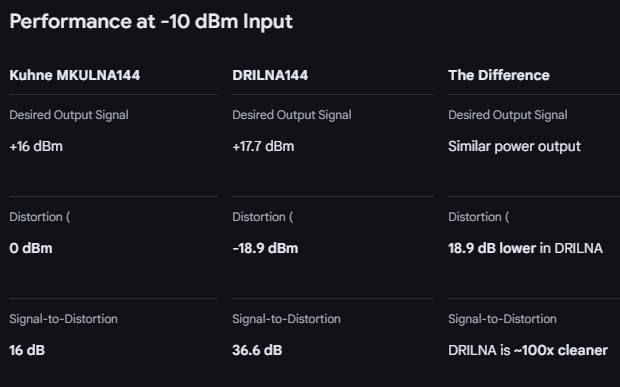
- The MKULNA144 (16 dB Ratio): At a 16 dB signal-to-distortion ratio, the "phantom" signals created inside the preamp are very loud. If you are trying to listen to a weak signal anywhere near that strong -10 dBm interferer, it will likely be buried under a thick layer of "splatter" or intermodulation noise.
- The DRILNA144 (36.6 dB Ratio): The distortion products are pushed down nearly 19 dB further. This creates a much "blacker" background. You gain a huge amount of overhead, allowing you to copy weak stations that the MKuLNA144 internal distortion would have completely masked.
Why the DRILNA wins here:
The DRILNA144 wins because it puts the "Intermodulation Ceiling" (the IIP3) much higher. As we discussed earlier, because the DRILNA has a 10.3 dB better IIP3, the distortion drops by double that amount (~20.6 dB) relative to the signal.
In a "quiet" location with no strong neighbors, you wouldn't notice a difference. But in a modern environment with cell towers, FM transmitters, or other high-power hams nearby, the DRILNA144 is the significantly more "robust" tool.
.png)
- The Intersection: The points where the red and green lines cross the dotted black line (Noise Floor) represent the absolute maximum signal the preamp can handle before it creates its own noise.
- The Green Zone: The shaded area represents the extra 6.8 dB of headroom provided by the DRILNA144. In this zone, the MKULNA144A is already producing distortion products louder than the noise floor.
- The Scale: This view is "zoomed in" near the noise floor to show exactly where the distortion "pops out" of the background.
- Headroom: The distance between the Blue Signal line and the Distortion lines represents your signal quality. You can see the green line stays much further away from the signal line as power increases.
My final conclusion: A New Standard in VHF Linearity
For decades, Kuhne Electronic has set the pace for high-performance RF development. Their MKULNA144A became a "workhorse" for serious VHF operators because Michael and his team published honest, real-world specifications—a hallmark of top-tier German engineering. When you choose a Kuhne, you choose a reputation for quality that has dominated the industry for years.
However, the DRILNA144 represents a modern evolution in this field. . It is not just an alternative; it is a specialized leap forward in handling hostile signal environments.
The Fact-Based Advantage
The comparison data makes the choice clear for the modern operator:
10.3 dB Linearity Breakthrough: While the MKULNA144A is an excellent performer, the DRILNA144 offers over 10 dB more headroom (IIP3). In the world of RF, this is a massive gap that transforms how a station handles interference.
20.6 dB Cleaner Signal: Thanks to the "2-for-1" physics of third-order distortion, the DRILNA144’s internal "phantom" signals (IM3) are over 100 times weaker than its predecessor. This provides a blacker background, allowing you to hear weak DX signals that would otherwise be masked by local splatter.
Expanded Dynamic Range: With nearly 7 dB of additional Spurious-Free Dynamic Range (SFDR), the DRILNA144 offers an extra "S-unit" of safety. It allows you to keep your receiver open and sensitive even when strong local stations or high-power contest neighbors are active.
The MKULNA144A remains a legendary piece of German engineering. But for the operator who demands the state-of-the-art in precision and linearity, the DRILNA144 is the new benchmark. It brings unprecedent IRL to the VHF spectrum allowing you to place a BPF ahead the preamp without destroying the BPF characteristics due a poor IRL, against all the traditional "ACADEMIA RULES" my aproach is to motivate stations with IM3 problems to fight in a very unconventional way where precision isn't just a goal, it's our heritage in LinkRF.
* The IRL orignally declare was -50dB, this is real when you have a perfect 50 ohms load in the preamp output, as soon you place the preamp with the BPF ahead and use the VNA 2 port the IRL move from -50dB to -30dB, this is totally normal and create some confusion, for that reason I will characterize the DRILNA144 as it have IRL=-30dBm, if the calibration over the bench, with the 50 ohm load in the ouput, reach only -30dB then when all parts are in place the IRL will derate to -5dB, a very unaceptable value. The input network used in the DRILNA allow me to reach even -60dB IRL but then the NF start to be affected, all DRILNA's are calibrated to reach a IRL between -45 to -52dB, then the values normalize to -28 to -30dB when the BPF is installed ahead the preamp, allowing the filter to work with no distortions.